Explained: Why Acche Din remain elusive for the Middle Class

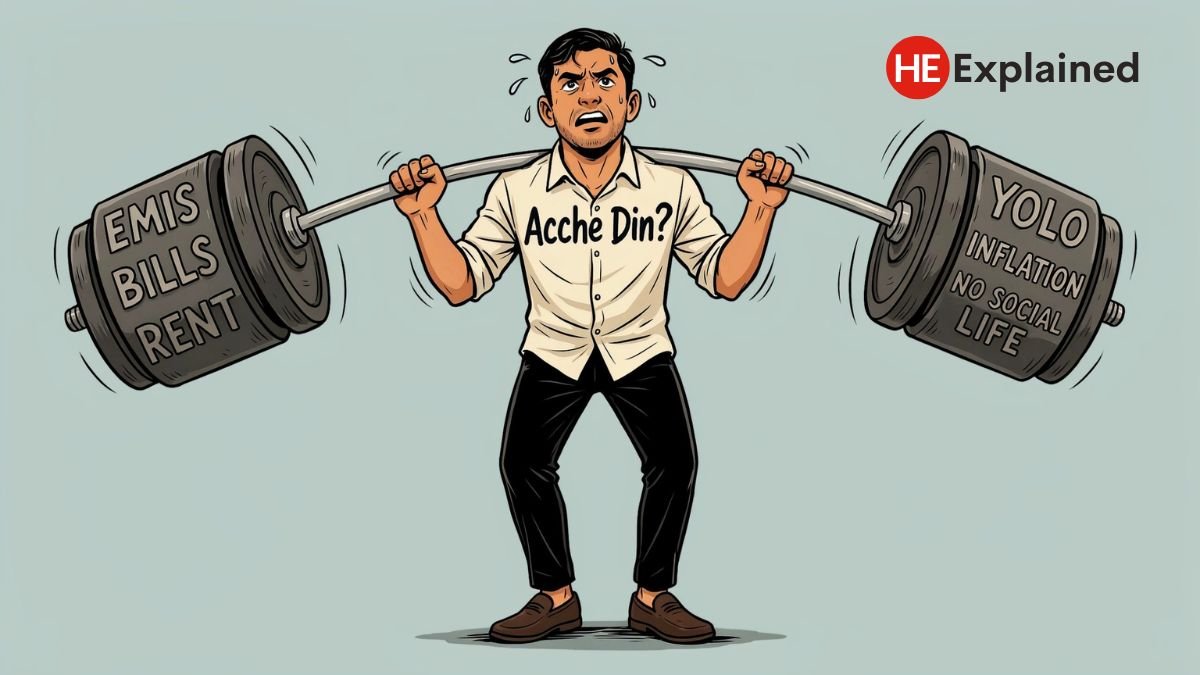
Achhe Din Aane Waale Hain
That was PM Modi’s slogan for the BJP’s 2014 Lok Sabha elections. 12 years later, this slogan has been largely forgotten, even as subsequent elections have highlighted the government’s achievements, but with little or no impact on the average Indian Middle Class.
For the likes of hardworking, corporate employees, the Acche Din slogan remains just a forgettable jumla that offered an evasive window of hope during the election season. Used for votes, they receive hardly any benefit from economic development, becoming a part of the so-called ‘laptop class’- who earn between ₹15-75 lakh per year. Eligible for income tax, these are the miniscule 3% of the population who actually file returns, after trying to squeeze through loopholes to reduce the tax burden.
Too rich for the government’s schemes and too poor for the politicians’s attention, these employees bear the brunt of geopolitical, economic, social and behavioural realities of India, alone, with hardly anyone to turn to.
The Stark Realities
A cushy IT job, a substitute for the conventionally sought-after government job, no longer offers the guarantee of consistent income, thanks to AI-driven technological disruption. Instances of layoffs have increased over the years, with many looking at freelance gigs to supplement their incomes.
The ‘laptop generation’ is struggling with multiple challenges simultaneously, while being largely on their own.
Negative Job Growth
India is facing a job crisis of a large magnitude, with a lack of jobs for the youth and growing job insecurity for middle-aged people. According to the Naukri Jobspeak Index, there has just been a 1% growth in white-collar jobs in 2026 from 11% six years ago. Almost 80% of 1.5 million engineering students don’t have a job after graduating, with their skills not enough for the broader job market. Many managers at the middle levels are forced to stay on to their jobs as there is no guarantee of better offers from rivals. They are stuck in what is called the ‘golden handcuff’ situation, where their salaries have hit a ceiling that cannot be undone.
Inconsistent incomes
Increased standard of living costs have forced millions of middle-class professionals to take on freelance gigs to supplement their incomes, sometimes through dangerous means. Enticed by unrealistic returns, some opted to put their money in risky Future and Options (F&O) trades, where SEBI says more than 91% of retail traders lose money, while others choose to gamble away their money in pyramid schemes as a shortcut to end their woes.
Besides that, those entirely dependent on inconsistent incomes face immense hardships when work dries up, for reasons beyond their reach.
YOLO led splurges
Constant comparisons and intense peer pressures force many to splurge on that Thailand holiday or the unaffordable iPhone that everyone has. A generation ago, this wouldn’t be possible, as cash remained king and was consistently treated as a finite resource.
Today, quick loan availability and the ease of paying through UPI has removed the barriers of finite resources, with marketers prodding consumers to spend based on their emotional states. Encouraged by social media, Indians have embraced the You Live Only Once (YOLO) mindset, spending way beyond their means to fulfill their aspirations and gain social acceptability.
Savings Collapse
The habit of saving- for a home, a bad day, an education, or a marriage- has largely worn away, as inflation continues to bite. According to official data, India’s net household savings are now just 5%, the lowest level in nearly 50 years. With societal challenges due to nuclear families, many are forced to live paycheck by paycheck. The government has aimed to address this by hiking the Provident Fund contributions, but that doesn’t truly reflect the challenges of the future.
The Path Forward
For the Middle Class, Acche Din essentially won’t be served to them on a platter- it would mean hustling, upskilling, and controlling the urge to splurge even when the world around you pressurizes you to do so.
It would mean fighting a system that refuses to change- as the status quo offers certain sections of the government a vested interest to keep going. For those who’d like to have their own home, a car, a stable income and a happy, healthy family, that would mean working way harder than your parents did for you, as the prevailing economic situations make it harder to dream of this, essentially making it a luxury that our parents took for granted.
<p>The post Explained: Why Acche Din remain elusive for the Middle Class first appeared on Hello Entrepreneurs.</p>